Technology News : Latest Tech News, New Gadgets, Mobile Phone, Laptop, Reviews: Apps – TechCrunch

Hot

Post Top Ad

Your Ad Spot
Showing posts with label Apps – TechCrunch. Show all posts

Saturday, 6 April 2019

VSCO sues PicsArt over photo filters that were allegedly reverse-engineered

April 06, 2019 0

Photo editing app-maker VSCO has filed a lawsuit against competitor PicsArt.

The suit focuses on 19 PicsArt filters that were supposedly “reverse engineered from VSCO’s filters,” with VSCO alleging it’s become a legal issue involving false advertising and violations of the app’s terms of service.

“VSCO has invested significant time and resources in developing its presets [a.k.a. filters], which represent valuable intellectual property of VSCO,” the company writes.

In a statement, PicsArt denied the suit’s claims:

VSCO is not a direct competitor, but they clearly feel threatened by PicsArt. VSCO’s claims are meritless. It’s disappointing that they have made these false claims against us. PicsArt will vigorously defend itself against these baseless claims and all options are under consideration.

Specifically, VSCO says that at least 17 PicsArt employees created VSCO accounts — probably not an uncommon competitive practice, but the suit claims they used those accounts to reverse engineer the filters, thus violating the terms in which users “agree not to sell, license, rent, modify, distribute, copy, reproduce, transmit, publicly display, publicly perform, publish, adapt, edit or create derivative works from any VSCO Content.”

In addition, the suit accuses PicsArt of engaging in false advertising by describing the filters in its PicsArt Gold subscription as “exclusive” and “only for [PicsArt] Gold users.”

Why is VSCO so sure that the PicsArt filters were based on its own? The suit says:

VSCO’s color scientists have determined that at least nineteen presets published by PicsArt are effectively identical to VSCO presets that are only available through a VSCO account. Specifically, VSCO determined that those PicsArt filters have a Mean Color Difference (“MCD”) of less than two CIEDE2000 units (in some cases, far less than two units) compared to their VSCO counterparts. An MCD of less than two CIEDE2000 units between filters is imperceptible to the human eye and cannot have been achieved by coincidence or visual or manual approximation. On information and belief, PicsArt could have only achieved this degree of similarity between its filters and those of VSCO by using its employees’ VSCO user accounts to access the VSCO app and reverse engineer VSCO’s presets.

The suit goes on to claim that VSCO’s lawyers sent PicsArt a letter in February demanding that the company identify and remove any filters that were reverse engineered or copied from VSCO. The letter also demanded “an accounting of all profits and revenues generated from such filters” and that PicsArt identify any employees who had created VSCO accounts.

In VSCO’s telling, PicsArt then responded that it was “in the process of replacing certain underperforming filters and modifying others,” including the 19 filters in question, but it only removed 17 — and supposedly two of the new filters “were similarly reverse engineered from VSCO’s proprietary presets.” The suit also says PicsArt has failed to provide the information that VSCO demanded.

VSCO does not appear to be suing for a specific monetary value, but the suit asks for “disgorgement of any proceeds obtained from PicsArt’s use of VSCO filters,” as well as injunctive relief, compensatory damages and “the costs of corrective advertising.”

You can read the full complaint below.

VSCO Complaint by on Scribd


from Apps – TechCrunch https://tcrn.ch/2CXpF6K
Read More

Friday, 5 April 2019

Snap is channeling Asia’s messaging giants with its move into gaming

April 05, 2019 0

Snap is taking a leaf out of the Asian messaging app playbook as its social messaging service enters a new era.

The company unveiled a series of new strategies that are aimed at breathing fresh life into the service which has been ruthlessly cloned by Facebook across Instagram, WhatsApp, and even its primary social network. The result? Snap has consistently lost users since going public in 2017. It managed to stop the rot with a flat Q4, but resting on its laurels isn’t going to bring the good times back.

Snap has taken a three-pronged approach: extending its stories feature (and ads) into third-party apps and building out its camera play with an AR platform, but it is the launch of social games that is the most intriguing. The other moves are logical and they fall in line with existing Snap strategies, but games is an entirely new category for the company.

It isn’t hard to see where Snap found inspiration for social games — Asian messaging companies have long twinned games and chat — but the U.S. company is applying its own twist to the genre.


from Apps – TechCrunch https://tcrn.ch/2YTNLZm
Read More

Skype now supports up to 50 group call participants, topping rivals

April 05, 2019 0

Skype is capitalizing on Apple’s struggles with Group FaceTime to attract attention to its own group calling features. Today, the company announced it’s doubling the number of people who can simultaneously participate in a group audio or video call. It now supports as many as 50 people at once, up from 25, previously.

With the expanded support for more participants, Skype tops the abilities of other popular messaging apps like WhatsApp, Google Hangouts and Instagram, and instead competes more directly with enterprise-grade calling solutions like Zoom, for example, which supports up to 100 or even 1,000 participants.

Skype also one-ups Facebook Messenger, which allows 50 people to join a chat but limits the screen to show  only the speaker after more than a half-dozen people join in. On Skype, however, the participants are shown in bubbles across the top of the screen and the end-user can choose whose feed they want to focus on in a multi-paned main window.

Notably, Skype’s update also puts it ahead of Apple’s FaceTime which now supports up to 32 people on group calls as of iOS 12.1.

But Group FaceTime has experienced some issues in recent months. A teenager found a security bug that allowed users to eavesdrop before calls were picked up. Apple disabled the feature, fixed the bug, then re-enabled Group FaceTime with February’s release of iOS 12.1.4. But the update also introduced a change to how the app works, as it required users have to have at least 3 people on a FaceTime call to begin with before they could use the “Add Person” button.

Skype, on the other hand, is simplifying how video calls start with the new release.

For groups under 25 participants, you can just ring the entire group at once, the company says.

And for larger calls, Skype added a notification option to replace ringing as the default. That means participants get a less obstructive, ping-style alert to join the call.

To use these new features, you’ll need to download the latest version of Skype.


from Apps – TechCrunch https://tcrn.ch/2YMRUOZ
Read More

Twitter’s latest test focuses on making conversations easier to follow by labeling tweets

April 05, 2019 0

Twitter continues to experiment with ways to make conversations on its platform easier to follow. In addition to its prototype app twttr, which is testing threaded replies, the company also recently tested labeling replies to highlight those from the “original tweeter” – meaning it would show when the person who first tweeted a post then replied within the conversation thread. Now, Twitter is changing up this labeling system again.

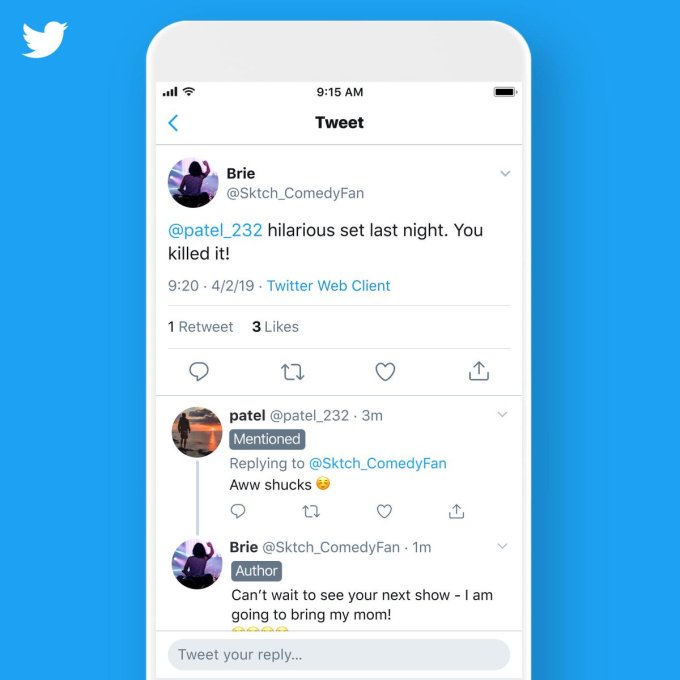
On Thursday, the company said a new test was rolling out which would instead label the “original tweeter” as “Author” – a term that’s a bit more straightforward .

“Original tweeter” had been a nod to the commonly used term”original poster,” which designates the person who started a conversation on an internet message board or online forum. But if the goal was to make Twitter easier to understand for those who are less tech-savvy, “original tweeter” may have been more confusing if they weren’t familiar with that reference.

In addition, Twitter is also now adding two new labels, “Mentioned” and “Following,” which will be added to other important tweets in conversation threads.

“Mentioned” will be added to any tweet posted by someone who the original tweeter…err, Author…had referenced in their first tweet. The “Following” label, meanwhile, will be added to tweets from those Twitter users you’re following, as a way to catch their replies when scrolling through long threads.

Oddly, these are the same sort of features that Twitter is trying out on its twttr prototype as well, but in a different way. In the invite-only testing app, the original poster is highlighted using a thin gray line next to their tweet, while those you’re following is a brighter blue.

Twitter’s larger goal here is to better design its app for longer discussions. However, the labels also can help in specific scenarios where the replies to a tweet include posts from a lot of parody accounts. Often, parody accounts have adopted usernames and profile pics to resemble that of the person they’re poking fun at – sometimes inadvertently confusing users and, other times, to blatantly troll or spam.

Despite the usefulness of features like labels, these sorts of minor changes feel like an odd thing for Twitter to focus its attention on, when users’ main demands are still an edit button and for the company to deal with abuse and harassment.

On the latter front, Twitter was recently spotted working on a “Hide Tweet” feature. While more controversial than a new label, a hide tweet button would have the potential to impact user behavior, as it allows a poster to hide the replies they didn’t like. As a result, those following a conversation would have to click a button to view these hidden replies. In other online forums, knowing that a trolling or unhelpful comment would be downvoted or removed has helped to stem bad user behavior and encourage better conversations. The feature, however, could be used to silence dissenting opinions, which some people don’t like.

If Twitter won’t roll out an edit button, experiments around dealing with trolls through product features would probably be more useful than continually tweaking Twitter’s extra little flourishes.


from Apps – TechCrunch https://tcrn.ch/2IkjayB
Read More

Snapchat launches Mario Party-style multiplayer games platform

April 05, 2019 0

Snap is unlocking a new revenue stream while giving you something to do in between chats and Stories. Today Snapchat debuts its Snap Games platform that lets you play real-time, multiplayer games while texting and talking with your friends. The platform is based off Snap’s secret late-2017 acquisition of PrettyGreat, an Australian game studio with talent from Halfbrick which built Fruit Ninja. That team built Bitmoji Party, a Mario Party-style mini-game fest, to show off the platform that includes five games from developers like Zynga and ZeptoLab. The games are rolling out worldwide on iOS and Android starting today.


To monetize the platform, Snapchat will let users opt in to watching six-second unskippable commercials that reward them with a power up or bonus in-game currency. Snapchat will share revenue from the ads with developers, though it refused to specify the split. It could be a little weird watching ads to more easily beat your friends. But down the line it’s easy to imagine Snapchat selling cosmetic upgrades via in-app purchases akin to Fortnite.


Snap announced the new Snap Games platform at its first-ever press event, the Snap Partner Summit in Los Angeles where it also announced an augmented reality utility platform called Scan, an ads network, and a way to put its Stories in other apps. The Information’s Tom Dotan and Amir Efrati first reported Snap was building a gaming platform and Cheddar’s Alex Heath reported it would end up launching today.

Snap Games could be considered a real-time spin on Facebook Messenger’s Instant Games platform, which has focused on porting well-known games like Pac-Man and other arcade titles to HTML5. Similarly, Snap Games don’t have to be downloaded separately as they’re piped in from the web. Users can browse available games by tapping a new rocket ship button in the chat bar.

With Bitmoji Party, your avatar competes with up to 7 friends simultaneously in a series of mini games where you have to stay balanced on a giant record as a DJ scratches it, or avoid getting knocked in the pool. You can also have another 24 friends spectate and rotate in. Winners earn coins they can use to buy dances to stunt on their competition. And with an ever-present chat bar, users can use text or voice to talk trash.

Rather than port in known IP, Snap recruited developers to build games exclusively for its vertical, real-time multiplayer format. Those include:

  • Alphabear Hustle from SpryFox – a fast-paced word puzzler
  • C.A.T.S. (Crash Arena Turbo Stars) Drift Race from ZeptoLab – a cutesy racing game
  • Snake Squad from Game Closure – a reimagining of the classic Snake game set in outer space
  • Tiny Royale from Zynga – a top-down battle royale shooter game that feels like a Game Boy version of Fortnite  top-down battle royale game
  • Zombie Rescue Squad from PikPok – A zombie shooter

Snapchat’s partner games (from left): Tiny Royale, Snake Squad, C.A.T.S. Drift Race


from Apps – TechCrunch https://ift.tt/2FQuEH0
Read More

WhatsApp’s Business app comes to the iPhone

April 05, 2019 0

More than a year after WhatsApp officially introduced its app for business customers to its first markets, the previously Android-only WhatsApp Business app is today launching on the iPhone. According to the Facebook-owned company, WhatsApp Business has been adopted by millions of businesses worldwide since its debut, but one of its customers’ most frequent requests was to offer the app on the iPhone.

The iOS version, like its Android counterpart, is designed to help small business owners reach their customers on smartphones.

That means it includes the ability for businesses to create profiles that include their description, email, address and website, as well as messaging tools for customer communication like automated greetings, quick replies and away messages.

Businesses also can use WhatsApp Business from their desktop computer, which in January rolled out tools to organize and filter chats as well as quick replies. At the time, WhatsApp said it had 5 million business customers.

The iOS app was spotted in testing last month on the Mexican iOS App Store, but today marks its official launch.

A WhatsApp Business platform is key to WhatsApp’s growth in emerging markets where first-time internet users have skipped over using computers to reach the web, and instead mainly get online through their mobile devices. Here, WhatsApp serves as a portal to the web — even more so than its parent company Facebook does — for many users.

Through the main WhatsApp app, users can connect with friends and family, join groups focused on their various interests and even get the news (or, unfortunately, fake news and hoaxes — something that WhatsApp is now trying to prevent). Being able to easily communicate with businesses was an obvious next step for the company not only in terms of serving these customers, but also for revenue generation.

The company makes money by charging Business API customers who have large volumes of incoming messages.

The free WhatsApp Business app for iOS is available today from the App Store in Brazil, Germany, Indonesia, India, Mexico, the U.K. and the U.S.

The company says it will roll out to more markets worldwide in the weeks ahead.


from Apps – TechCrunch https://ift.tt/2WIiy9K
Read More

Thursday, 4 April 2019

Snapchat will power Stories & ads in other apps

April 04, 2019 0

Snapchat’s found an answer to the revenue problem stemming from its halted growth: it will show its ads in other apps with the launch of Snapchat Ad Kit and the Snapchat Audience Network. And rather than watching as other apps spin up their own knock-off versions of its camera and Stories, it will let apps like Tinder and Houseparty host Stories inside their own products that users can share to from the Snapchat camera with Stories Kit. They’ll both be launching later this year, and developers interested in monetization and engagement help can apply for access.

Snapchat debuted the big new additions to its Snap Kit at its first-ever press event in Los Angeles, the Snap Partner Summit where it also announced a new augmented reality utility platform called Scan. Over 200 apps have already integrated the privacy-safe Snap Kit that lets users login to other apps with Snapchat, bring their Bitmoji, view Our Stories content, and share stickers back to Snapchat.

But later this year, developers will be able to earn money off of Snap Kit with Ad Kit. Developers will integrate Snapchat’s SDK, and then Snap’s advertisers will be able to extend their ad buys to reach both Snapchat users and non-users in other apps. Snapchat will split the ad revenue with developers, but refused to hint at what the divide will be, as it’s still gauging developer interest. The move is straight out of Facebook’s playbook, essentially copying the functionality and name of Facebook’s Audience Network.

There are still big questions about exactly how Snapchat will reach and track ad views of non-users, and how it will be able to provide brands with the analytics they need while maintaining user privacy. But simply by making Snapchat’s somewhat proprietary vertical vdieo ad units reusable elsewhere, it could prove it has a scale to be worth advertisers’ time. The lack of scale has often scared buyers away from Snapchat. But now Snap CEO Evan Spiegel says that “In the United States, Snapchat now reaches nearly 75 percent of all 13-34 year-olds, and we reach 90 percent of 13-24 year-olds. In fact, we reach more 13-24 year-olds than Facebook or Instagram in the United States, the UK, France, Canada, and Australia.”

To keep those users engaged even outside of Snapchat, it’s adding App Stories through Story Kit. Snapchat users will see an option to share to integrated apps after they create a photo or video. Those Stories will then appear in custom places in other apps. You’ll see Snaps injected alongside people’s photos when you’re browsing potential matches in Tinder. You can see what friends on group chat social network Houseparty are doing when they not on the app. And you can see video recommendations from explorers on AdventureAide.

Snap also has some other fun new integrations and big name partnerships. Bitmoji Kit will bring your personalized avatar off your phone and onto FitBit’s smart watches and Venmo transactions. Netflix will let you share preview images (but not trailers) from its shows to your Snapchat Story. A new publisher sharing button for the web will let you share articles from the Washington Post and others to your Story.

By colonizing other apps with its experience, Snapchat decreases the need for them to copy it. Instead they get the original, and a lot less development work. And the platform makes your Snapchat account more valuable around the web. These integrations might not grow Snapchat too much, but it could help it keep its existing users happy and squeeze more cash out of them.


from Apps – TechCrunch https://ift.tt/2FUko0j
Read More

Snapchat launches Scan, its AR utility platform

April 04, 2019 0

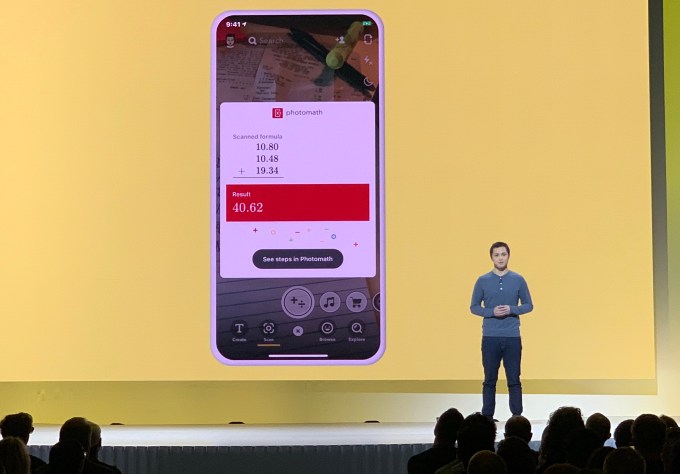
Point and shoot? No, point and interact. Snapchat can now help with your homework. The app’s camera is becoming the foundation of an augmented reality developer platform known as “Scan”. Snap today announced partnerships with Photomath to add the ability to solve math problems, and Giphy for detecting objects which then spawn related GIFs on screen. Scan will roll out to all Snapchat users soon, and developers interested in joining the platform can contact Snap.

Snapchat Scan spawns Giphy GIFs based on what’s around you

Previously, Snapchat’s camera could identify songs with Shazam and recognize objects so you could buy them on Amazon. But now instead of just offering a few scattered tools, Snapchat is crystallizing its plan to let you reveal hidden information about the world around you.

“Our camera lets the natural light from our world penetrate the darkness of the Internet . . . as we use the Internet more and more in our daily lives, we need a way to make it a bit more human” said Snap CEO Evan Spiegel at the company’s first ever press event, the Snap Partner Summit.

Scan with Photomath solves math problems

Others like Blippar have tried to build AR utility platforms, but they lacked the community and daily use necessary to already be top of mind when people want to scan something. But Snap CEO Evan Spiegel today revealed that “In the United States, Snapchat now reaches nearly 75 percent of all 13-34 year-olds, and we reach 90 percent of 13-24 year-olds. In fact, we reach more 13-24 year-olds than Facebook or Instagram in the United States, the UK, France, Canada, and Australia.”

The comparison data comes Facebook’s ad manager estimates which aren’t always totally accurate. Still, the stats demonstrate that amongst the audience likely to explore the world via augmented reality, Snapchat is huge.

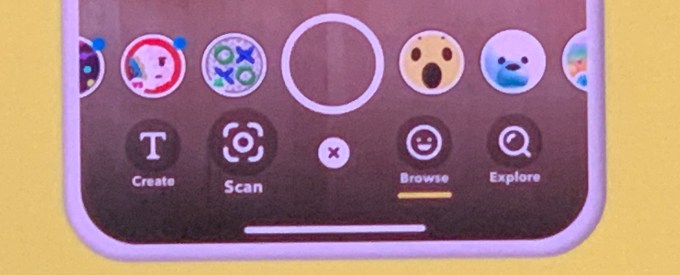
When users tap and hold on the Snapchat camera, they’ll start to Scan their surroundings. Answers to math equations will magically appear. If you view a $10 bill, Hamilton will come alive and sing a song from the musical. Scan a slice of pizza and a dancing Giphy pizza slice appears. Users will also see the new Snapchat AR Bar with dedicated buttons to Scan, create a lens, or explore the 400,000 AR Lenses created by Snapchat’s community. 75 percent of Snap’s 186 million daily users play with Lenses each day, combining into 15 billion total plays to date. Scan was built off the acquisition of a startup called Scan.me, which until now has powered Snap’s QR Snapcodes that let people add friends or unlock Lenses.

Snap’s new AR Bar

Outside of utility, Snapchat is also adding a slew of new creative AR features to keep that audience entertained and loyal that are launching today. For example, it’s launching Landmarkers, which uses point cloud data from user submitted Our Stories of major landmarks to power animated AR transformations of famous places. Now the Eiffel Tower, Buckingham Palace, LA’s Chinese Theater, DC’s Capitol Building, and NYC’s Flatiron Building can spew rainbows, shoot lightning, and more.

Snapchat’s new Landmarkers

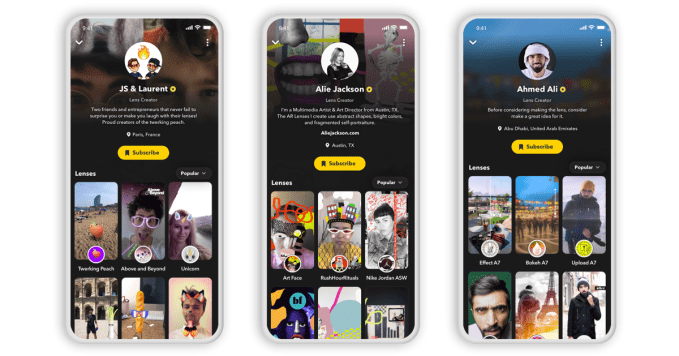
For developers and Lens creators using Snap’s Lens Studio tools, Snap is launching new Creator Profiles where they can show off all the Lenses they’ve contributed. They’ll all have access to new AR templates for hand, body, and pet effects that take care of all the hardcore computer science. Creators just add in their graphical assets like a mustache for dogs, fireballs that shoot out of people’s hands, or rainbows that appear over someone when they hold their arms out.

Snapchat’s new Lens Creator profiles

Snap will even surface relevant community Lenses in the Lens Carousel based on what its Scans pick up. One place it falls short though is there’s no direct monetization opportunities for independent Lens creators, beyond Snap occasionally connecting the best AR artists to brands for paid Lens development deals. Snapchat admits it will need to create better incentives long-term.

At a big press briefing yesterday, the company’s top execs explained that growth isn’t Snapchat’s success metric any more. That’s convenient considering the launch of Instagram Stories cut Snap’s growth from 17 percent per quarter to it actually losing users and only stabilizing this quarter. Instead he says deepening user engagement, and thereby the ad revenue users generate, is Snap’s path forward.

The more Snap gets users playing with augmented reality filters and the better development tools it provides, the more brands and devs will pay to promote their Lenses in the Lens Carousel or through video ads where users swipe up to try a Lens.

But that engagement is also critical to beating Facebook and Instagram to the next phase of AR. Instagram Stories might have 500 million daily users, but they’re mostly applying AR to their face, not to interact with the world. Snapchat needs as many fun AR entertainment experiences like Landmarkers as possible to normalize AR exploration, which will unlock the potential of the Scan platform. That could one day fuel affiliate fees from AR commerce sales and other revenue streams.

Plus, Snapchat says Lenses are coded to be compatible with not just iOS and Android, but future AR hardware platforms. To build the biggest repository of AR experiences, Snapchat needs help, as I wrote two years ago that Snap’s anti-developer attitude was an augmented liability. Now it’s finally building the tools and platform to harness a legion of developers to fill the physical world with imaginary wonder. “If we can show the right Lens in the right moment, we can inspire a whole new world of creativity” concludes Snap co-founder Bobby Murphy


from Apps – TechCrunch https://ift.tt/2FVWuBE
Read More

Post Top Ad

Your Ad Spot